Your daily source for the latest AI tools, automation strategies, and productivity insights.
The Rise of AI and the Transformation of the Modern Workplace
Introduction: The Beginning of a New Era Artificial Intelligence (AI) is no longer a futuristic idea—it’s here, shaping every corner of the modern workplace. From small startups to Fortune 500 corporations, AI has become the backbone of productivity, creativity, and decision-making. What began as a set of experimental algorithms in research labs has evolved into systems capable of writing code, generating marketing content, managing supply chains, and even predicting human behavior. In this first part of our five-chapter series on How Artificial Intelligence Is Changing the Future of Work, we’ll explore how AI has risen to become the most transformative force in the global economy. We’ll trace its evolution, its integration into the workplace, and how it’s redefining what it means to “work” in the 21st century.
10/27/20255 min read
1. A Brief History: From Automation to Intelligence
AI didn’t appear overnight. Its roots go back to the mid-20th century, when early computers were used to perform repetitive calculations. In the 1950s, pioneers like Alan Turing and John McCarthy began exploring whether machines could “think.” But it wasn’t until the 2010s—thanks to massive data growth and the power of GPUs—that machine learning and neural networks achieved real breakthroughs.
The workplace, once dominated by manual labor and repetitive office tasks, began to shift. Early automation replaced physical effort, but AI took it further—it began to replace cognitive labor. Tasks like writing reports, analyzing data, and making forecasts that once required human intelligence could now be done by machines, faster and often more accurately.
AI evolved from assisting humans to collaborating with them. Today, systems like ChatGPT, Google Gemini, and Anthropic’s Claude help professionals brainstorm, analyze, and automate decisions across industries.
2. The Age of Collaboration: Humans + Machines
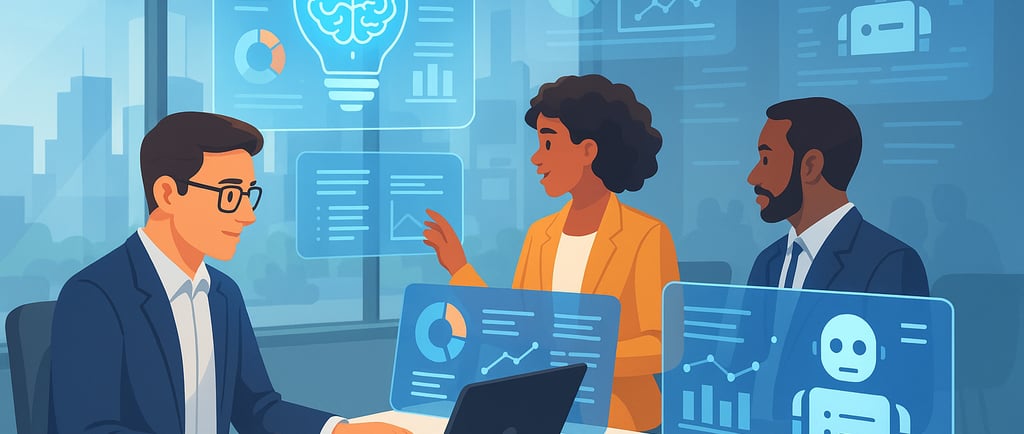
The 2020s mark a new era—not one where machines replace humans, but where they augment them. This concept, often called “augmented intelligence,” is central to how modern companies integrate AI.
In marketing, AI tools predict consumer behavior and personalize ads.
In finance, they assess risk and detect fraud in real time.
In construction and engineering, AI analyzes design drawings, estimates costs, and even monitors safety compliance.
In healthcare, AI systems diagnose diseases faster than doctors could a decade ago.
A 2024 Deloitte report found that 73% of global executives now use AI for at least one business function. What’s more revealing is how they use it—not as a replacement for employees, but as a “co-worker” that helps them do more with less effort.
This synergy between human creativity and machine precision is what’s reshaping the DNA of the workplace. The companies that succeed in the coming decade will be those that understand this collaboration deeply and build workflows where AI and people amplify each other’s strengths.
3. The New Workplace: Where AI Lives
Walk into a modern office—physical or virtual—and you’ll find AI everywhere, though you may not see it. It’s in the recommendation engines suggesting what you read next, in the software that schedules your meetings, and in the chatbots that respond to customer inquiries 24/7.
Let’s break down how AI is transforming different work environments:
a. Remote and Hybrid Work
Post-pandemic, remote work became standard. AI tools like Notion AI, Slack GPT, and Microsoft Copilot are now essential for managing distributed teams. These systems handle repetitive coordination tasks—summarizing meetings, drafting follow-ups, and tracking progress—allowing humans to focus on creative and strategic decisions.
b. Hiring and HR
AI recruitment platforms analyze resumes faster than any human HR department. They assess not only skills but also potential cultural fit using sentiment analysis and behavioral data. This speeds up hiring, reduces bias, and saves millions in operational costs.
However, this also introduces new challenges: transparency, fairness, and the risk of algorithmic discrimination. We’ll explore these ethical concerns more in Part 4 of this series.
c. Decision-Making and Analytics
AI thrives in data-rich environments. Decision-makers now use predictive analytics to forecast market trends, monitor employee productivity, and allocate resources. The difference is no longer about having data, but about interpreting it intelligently.
In this sense, AI is not replacing managers—it’s making them smarter.
4. How AI Rewrites Productivity
Productivity once meant working longer hours or managing more employees. Now, it’s measured by how well organizations leverage automation. According to McKinsey’s 2025 Global AI Impact Report, companies using AI tools experience a 25–40% increase in efficiency across departments.
Here are some real-world examples:
Goldman Sachs uses generative AI to draft financial summaries and client memos.
IBM deploys WatsonX for code generation and data insights, cutting project times by up to 60%.
Amazon uses predictive AI to optimize inventory and logistics—saving billions annually.
Even small businesses benefit: AI content generators, bookkeeping bots, and customer-support chat systems let one-person startups operate like full-scale enterprises.
The new definition of productivity isn’t doing more work—it’s doing smarter work.
5. Job Transformation, Not Elimination
The fear that “AI will take our jobs” has dominated headlines for years. But history shows a more nuanced pattern. Each technological revolution—from the steam engine to the internet—has destroyed some jobs but created entirely new ones.
AI follows the same path. While it automates repetitive roles, it’s also giving rise to careers that didn’t exist a few years ago:
Prompt engineers who craft the perfect instructions for AI systems.
AI ethicists ensuring algorithms align with human values.
Data curators, model trainers, and automation designers.
According to the World Economic Forum’s 2025 Future of Jobs Report, AI is expected to create at least 97 million new roles globally. Most of them will require human judgment, emotional intelligence, and problem-solving—skills that AI still can’t replicate.
So, instead of replacing the human workforce, AI is reshaping it. The challenge isn’t avoiding automation—it’s learning to work with it.
6. The Psychological Shift: Redefining “Work”
The integration of AI into the workplace isn’t just technological—it’s psychological. People are rethinking what “work” even means. When a machine can write an email, analyze data, and schedule meetings, what’s left for humans?
The answer: innovation, empathy, and strategy.
In other words, humans are moving up the cognitive ladder. Work is shifting from execution to ideation. AI handles the how; humans focus on the why.
This shift brings new questions:
How do we measure performance when machines share the workload?
What motivates employees when efficiency is automated?
How do leaders build trust in an AI-powered environment?
Forward-thinking organizations are already responding by reimagining leadership training, designing hybrid human-AI teams, and emphasizing emotional intelligence as a key workplace skill.
7. Challenges and Growing Pains
Every revolution comes with turbulence, and AI is no exception. Some of the main challenges facing businesses today include:
Data privacy: AI systems depend on massive datasets that often contain sensitive information.
Bias and fairness: Algorithms can unintentionally replicate societal prejudices.
Job displacement: While new jobs emerge, many workers struggle to transition.
Trust: Employees often resist automation, fearing loss of control or oversight.
Successful companies address these issues transparently. They train employees in AI literacy, promote open dialogue about automation, and use ethical frameworks to guide their AI deployments.
8. Looking Forward: The AI-Driven Economy
As AI becomes the new infrastructure of the digital economy, we’re entering an era where every company is an AI company. The difference between winners and losers won’t be whether they adopt AI, but how intelligently they do it.
Businesses that thrive will:
Integrate AI into core strategy, not as a side tool.
Foster a culture of continuous learning.
Prioritize human creativity and ethics as much as efficiency.
AI won’t make human work obsolete—it will make it more meaningful. The routine fades, the creative remains.
Conclusion: A New Definition of Work
The rise of Artificial Intelligence marks not the end of human labor, but its transformation. Work is no longer about routine or repetition—it’s about collaboration between people and intelligent systems.
As we stand on the brink of this new era, one thing is clear: AI is not the future of work—it is the present. The real question is how fast individuals, companies, and societies can adapt to this reality.
Follow
Subscribe
info@smartworkai.com
© 2025. All rights reserved.