Your daily source for the latest AI tools, automation strategies, and productivity insights.
The Impact of Artificial Intelligence on Global Employment and the Future Job Market
Discover how artificial intelligence is reshaping the global workforce, creating new opportunities while redefining traditional jobs in 2025 and beyond.
10/26/20254 min read
Introduction
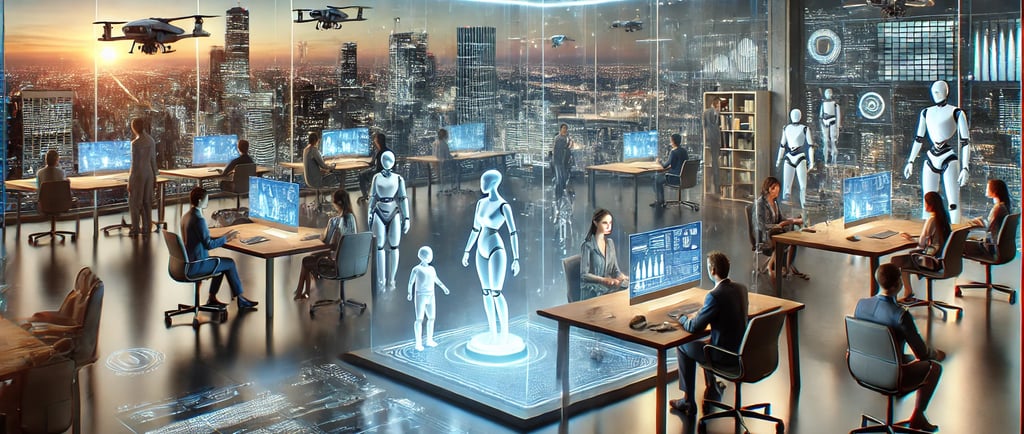
Artificial Intelligence (AI) has become the defining force of the 21st century economy. In the early 2020s, it started as a tool to automate small tasks — writing emails, analyzing data, and managing calendars. By 2025, it has evolved into a global transformation engine, capable of replacing repetitive human work while unlocking entirely new career paths.
The question is no longer whether AI will change the job market — it’s how deeply it already has. From factories to finance, from design to healthcare, AI is redefining what it means to “work.” While many fear mass unemployment, history suggests something different: every major technological revolution destroyed some jobs but created others — often better ones.
In this article, we’ll explore the real impact of AI on global employment, the industries most affected, and how workers and businesses can adapt to the new world of intelligent automation.
1. A New Industrial Revolution — The AI Economy
AI represents the Fourth Industrial Revolution. The first was driven by steam, the second by electricity, the third by computers — and the fourth by intelligence itself.
What makes AI different is its universality. It doesn’t just change one sector; it changes every sector.
In agriculture, AI drones analyze crop health.
In logistics, AI routes deliveries in real time.
In entertainment, AI writes screenplays and designs music.
In construction, robots lay bricks with precision.
According to PwC’s 2025 Global AI Outlook, AI could contribute over $15.7 trillion to the world economy by 2030. About $6 trillion of that will come from productivity improvements — meaning fewer hours, more output.
But where there’s growth, there’s also disruption. The World Economic Forum estimates that 85 million jobs may be displaced by automation, but 97 million new roles could emerge that are better suited to AI-human collaboration.
2. Jobs Most at Risk
Not every job is equally safe. Tasks that are predictable, routine, and data-driven are the easiest for AI to handle.
a. Manufacturing and Logistics
Robotics and computer vision have already replaced many manual labor roles. Automated warehouses run 24/7, with robots guided by AI optimizing routes and picking efficiency.
b. Data Processing & Entry-Level Office Work
AI can analyze documents, generate reports, and manage spreadsheets faster and more accurately than humans. Companies using tools like GPT-powered assistants save up to 70% of clerical time.
c. Customer Support
AI chatbots such as Intercom Fin and Zendesk AI can resolve most customer queries instantly. Humans are now handling only escalations that require empathy or complex judgment.
3. The Rise of New AI-Powered Jobs
While some jobs disappear, others evolve or emerge entirely new. These are roles where human creativity, emotion, and critical thinking merge with AI capability.
a. AI Trainers and Prompt Engineers
AI models need constant tuning. Trainers teach them context, tone, and cultural nuance. Prompt engineers, meanwhile, design inputs that produce optimal outputs — a new, high-paying digital skill.
b. AI Ethics & Policy Specialists
As AI grows, so do concerns about bias, privacy, and fairness. Professionals are now needed to define how AI should behave responsibly.
c. Data Curators & Analysts
AI depends on data. People who can collect, clean, and interpret that data are essential — the “fuel managers” of the AI age.
d. Human-AI Collaboration Managers
Every company adopting automation needs someone who bridges the human-machine gap — ensuring people and algorithms work together productively.
4. The Human Skills That AI Can’t Replace
Even as AI takes over repetitive work, it struggles with uniquely human traits:
Creativity – true innovation still comes from human intuition.
Empathy – understanding emotions is beyond algorithms.
Ethics – moral reasoning remains human territory.
Strategic judgment – AI can suggest, but not decide with full context.
Future workers must double down on these irreplaceable abilities.
According to Harvard Business Review, emotional intelligence, complex problem-solving, and creative thinking are now the top three skills sought by employers in the AI era.
5. How Businesses Are Adapting
Forward-thinking companies are blending AI with human potential instead of replacing it.
Microsoft uses Copilot tools to make employees faster, not redundant.
Amazon uses robotics to handle physical strain but still relies on human oversight.
Media firms employ AI to draft articles but keep editors for quality and voice.
The most successful organizations treat AI as an augmentation tool — one that enhances workers’ efficiency while freeing them for higher-value work.
6. Governments and Global Policy
AI’s rapid rise has forced governments to rethink labor policy. The European Union’s “AI Act,” the first major regulation of its kind, enforces transparency and ethical use. Meanwhile, countries like Canada and Singapore are investing heavily in AI upskilling programs for workers in vulnerable sectors.
Global leaders are now focusing on AI education, re-skilling programs, and ethical deployment rather than fighting automation itself.
7. The Gig Economy and AI Freelancers
AI is also fueling a new gig economy. Freelancers are using ChatGPT, Midjourney, and Jasper to deliver more projects faster — often increasing their income by 50–100%.
But platforms like Upwork and Fiverr now face a new challenge: how to differentiate human-created content from AI-generated ones. This tension may lead to hybrid jobs, where human creativity validates AI output.
8. What the Future Job Market Looks Like (2025–2035)
Here’s what experts predict for the next decade:
More hybrid roles: People using AI tools daily, like “marketing analyst + AI operator.”
Fewer low-skill jobs: Automation will continue to replace predictable labor.
Explosive demand for AI literacy: Everyone, from teachers to doctors, will use AI.
Rise of micro-entrepreneurship: Individuals leveraging AI tools to create one-person businesses.
By 2035, the average professional may manage 3–4 AI assistants — the same way managers today oversee interns.
9. How to Future-Proof Your Career
Learn AI tools (ChatGPT, Notion AI, Midjourney, Jasper).
Develop soft skills (communication, leadership, adaptability).
Stay curious and keep learning.
Build your personal brand — employers hire humans, not just skill sets.
The people who thrive will be those who treat AI as a colleague, not a competitor.
Conclusion
AI will reshape work — but not destroy it. It’s a force multiplier for human intelligence, not a substitute. Those who learn to collaborate with it will unlock unprecedented efficiency, creativity, and opportunity.
The future of jobs isn’t human vs. AI — it’s human + AI = progress.
Follow
Subscribe
info@smartworkai.com
© 2025. All rights reserved.